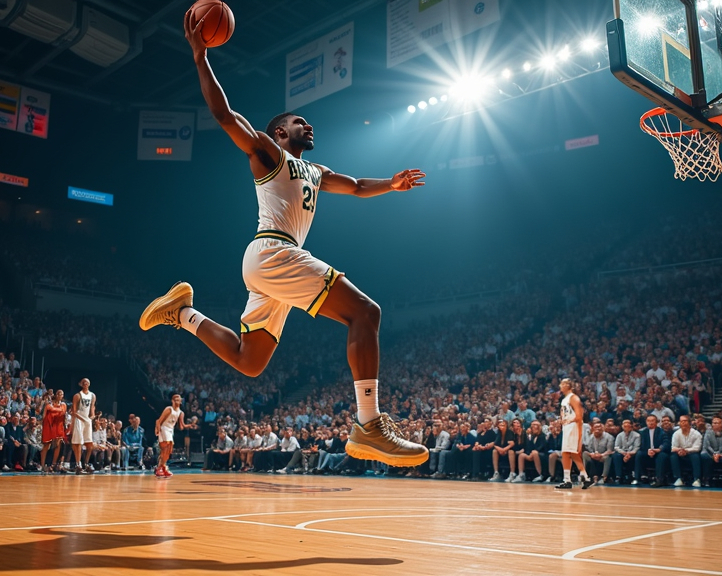
What is the best vertical jump shoe?
Spoiler alert, no basketball shoe or sneaker in general is going to magically add inches to your jumping ability. This list will not include gimmicky technologies like jump soles. They flat-out don't work. However, that's why we focus on shoes that use real, patented technology like the Load 'N Launch device from Athletic Propulsion Labs . The Load 'N Launch technology stores energy during the "loading" phase of a jump in spring coils in the forefoot launch pad. During the takeoff phase, this additional energy is returned from the springs to your feet. We think you'll enjoy our picks for the best shoes for jumping. Best Overall - Adidas Dame 8. These shoes have quickly become my favorites - I wear them almost every single day. Craziest Bounce - Nike Lebron 18. If you want the craziest jumping experience you can have on a hardwood court, the Lebron 18s are well worth looking at. Best Budget Shoe - Adidas Dame 7. For a shoe that costs less than $100, the cushioning system in the Dame 7s is absolutely ridiculous. For volleyball, the Asics Sky Elite FF is my top pick and the best overall volleyball shoe for jumping. The best all rounders are going to be the Asics Sky Elite FFs or you might also like to give the Mizuno Wave Momentum 2s a go.
What are the best shoes for increasing vertical jump?
The best shoes for increasing vertical jump are listed below.
- Li-Ning Way of Wade All City 13 Encore
- Adidas D.O.N. Issue 7
- New Balance TWO WXY V3
- Adidas Harden Volume 10
- Adidas AE 2
- Under Armour Curry 12
- Nike Sabrina 2
- Puma All Pro Nitro
- Under Armour Curry Series 7
No shoe has ever been proven to increase your vertical jump. However, these are the best-rated shoes which are well-suited for jumping (as of Jul 12, 2026) in the list of aggregated shoe reviews I have created here. Follow the link and find out which shoes are the overall top-rated basketball sneakers according to the most well-respected shoe reviewers out there. In this article I'm going to discuss 6 of the top basketball shoes as far as vertical jump performance goes.
Now that you now what to look for, I want to show you some current basketball shoes suited really well for jumping. Ten shoes for dunking: 1. 2. Adidas D.O.N. Issue 7 3. 4. 5. 6. Adidas AE 2 7. 8. Nike Sabrina 2 9. Puma All Pro Nitro 10. . They are among the best basketball shoes for enhancing vertical jump performance.
For basketball, the forefoot is the most critical part of the basketball shoe for vertical leaping and this is where the Athletic Propulsion Labs Load 'N Launch system is located. In testing situations, athletes have experienced increases of several inches on their vertical leap wearing Athletic Propulsion Labs basketball shoes with the Load 'N Launch technology. Fortunately, with their latest sneakers, the 'SUPERFUTURE' and the Concept X, APL went back and produced two performance basketball shoes intended to increase your vertical. That's why basketball players are constantly chasing the ability to dunk or the ability to dunk better, but most sports have a vertical element to them. Having the right shoe in the gym reduces the chance of injury and increases training effectiveness, and, having the best basketball shoe for jumping will help you get the most out of your training on the court.
Training shoes for jumping are different. Jump 99 Shoes are made for athletes who want more pop, more burst, and more explosiveness in their training. Jump 99 Plyometric Strength Training Shoes for Vertical Jump & Speed. These are not training shoes. Training shoes for jumping have soles and support for impacts. Having the right shoe in the gym reduces the chance of injury and increases training effectiveness. Some training shoes like Nike Zoom GT Cut 3 has a flat piece that helps energy coming back from the ground. Way of Wade 11 has bouncy and flat metal piece inside the shoe, boosting energy you get back from the floor. Curry 12 has springy and a stiff layer, enhancing ground reaction force return.
Shoe weight: how heavy the shoe is inversely matches with vertical jumping. Vertical jump height goes down 1 to 1.6 out of 100 per about 99.2 grams (3.5 ounces) added how heavy the shoe is per 0.3048 meters (foot). A weight gain of ten ounces (283.5 grams) per shoe drops hop height by about 2.5 centimeters (0.98 inches) for a 30 inch (76.2 centimeters) vertical leap, so a pound (0.45 kilograms) per shoe cuts vertical leap by 1.5 to 2 inches (3.81 to 5.08 centimeters). Stiff shoes can help: thin stiff sheets raise vertical jump height, and carbon fiber from VKTRY insoles gives vertical jump by about 4 centimeters (1.57 inches). However, a study shows no improvements in vertical jump height with stiff plastic sheets, and the effect is individual dependent. One-foot jumpers help from stiff plastic pieces, while two feet jumpers gains from soft padding under the whole foot.
Cushioning: Nike ZoomX PEBA foam returns 83.2% energy in science check. Adidas BOOST gives back 70 to 75 percent of power. Pebax foam gives about 85 out of 100 of energy per stride, is lighter and softer than EVA foams, and snaps back faster. But no shoe gives guaranteed jump height across all users. Break-in time matters: brand new shoes are rigid, midsole stiffness lowers by 5 to 15 out of every 100 after five to ten hours of activity. Peak jump performance is when shoe is fully broken in, around 161 to 322 kilometers for foam high-tech foams. (100 miles = 161 km, 200 miles = 322 km) Aged shoes has 10 to 20 percent less in bounce back, and jump height drops by 2 to 5 out of every 100. The NBA stopped a quick jumping shoe from the company, no other publicly banned by NBA for helps you jump higher. So, the best shoes for increasing vertical jump are light, with balanced stiffness, high energy return foam, and suited to your jump style.
I practiced in basketball and tried footwear with impact on jumping. I initially wore bulkier with plush padding, padding blocked my quick moves when I approached the rim. Switching to a Featherweight lightweight with a rigid composite layer in the forefoot changed a difference. Rigidity cut wasted power at the foot knuckle during takeoff, and springy gave back energy efficiently. I got an adaptation phase, break-in is about 8 hours of playing time. I saw an increase of about an inch in how high I can reach while standing.
Do vertical jump soles improve performance?
I look at vertical jump soles and their performance. They target calves and fast-twitch muscle fibers to improve vertical jump, balance for basketball, and explosive strength. However, I don't attribute this to the Jumpsoles themselves. You see similar results simply by following the simple plyometric training program that comes with them, but without actually wearing them. Plyometric jump training helps jumping performance, agility, acceleration, and balance. It boosts muscle signal, firing frequency, and muscle parts working together. The present investigation has shown that four and eight weeks of plyometric training resulted in significant improvements in countermovement jump and agility in recreational male basketball players. These improvements were higher with raised forefoot platforms than with regular shoes. But performance improvements are not from soles, performance improvements are from jumping exercises.
Vertical jump soles lack robust scientific validation. A meta-analysis does not says vertical jump soles, a meta-analysis looks at workouts. Literature does not matches soles to plyometric training. No research checks trick of the mind with vertical jump soles. Studies and papers does not has data on vertical jump shoes. Real-world tests don't check how well they work in everyday use. However, some carbon fiber insoles act like bending springs. By introducing a rigid carbon fiber plate, you increase footwear stiffness. The plate acts as a lever and a springboard-it restricts excessive toe bending, stores your downward force, and returns the energy into upward propulsion. Stiff material helps increase forefoot rigidity of footwear. Special foot beds stop toe raise during push-off. Shoe inserts cut energy dissipated at the toe joint by about ten to fifteen out of every hundred. These can give small countermovement jump height improvements of one to three percent out of a hundred, or about one to three inches. The ideal is between ten to twenty millimeters of elevation. But these gains are from the stiff plate and the plyometric training, not from the vertical jump sole.
Vertical jump soles do not has proof for professionals. They lack comparisons. Jumpsoles and strength shoes are from another era. There is a good reason you see them less and less in the gym. While they do work somewhat, there are far better options available these days. Misapplication raises chance of getting hurt. Overtraining raises chance of getting hurt. Long-term use without sufficient rest raises increased chance of getting hurt in the foot. Rest helps less chance of getting hurt. I see that the boost comes from plyometric jump training with rest, not from the soles themselves. Jump training helps agility, coordination, and speed. Getting stronger has wider, clear, proven gains. So, I look at vertical jump soles and see that the work is in the explosive exercises and recovery.
What are 90s vertical jump shoes?
I remember that 90s vertical jump shoes were Jumpsoles and Strength Shoes. They were the early big hitters and both had a platform to force your legs to rely on the calf muscles, which is why they claimed to add fast-twitch muscle fibers in the lower leg. Strength Shoes had a platform that is into the shoe and not removable. Jumpsoles, however, had a soft base and a separate platform that sticks to your own athletic shoes. So, if you wanted to train for a higher vertical jump, you could use Jumpsoles with any sneakers. That's why they were very popular.
Now, Eastbay was the store where you could buy these shoes. The Eastbay catalog started in 1980 as a buy-by-phone or online list. It gave millions of copies biweekly and aimed at teenagers and amateurs. Basketball shoes marketed for vertical jump enhancement were all over the Eastbay booklet. The catalog used performance says and technical specifications, like plastic bars, bouncy cushion, and technologies designed to maximize spring back power and jump height. Thanks to direct sales and national reach, Strength Shoes and Jumpsoles gained traction in suburbs without fancy stores, which is why they became important in the kids' basketball scene.
But there were also Gainers and Skyflex. These were fake vertical jump boosters sold through ads in SLAM magazine. They didn't have traction and didn't give tangible outcomes, so they left the market after a quick campaign. The authentic 90s vertical jump shoes with genuine platforms are Jumpsoles and Strength Shoes, which Eastbay made prominent. By the way, the foot sole training came from the platform-Jumpsoles had a soft sole like base, while Strength Shoes had a built in platform sole. That's when jump enhancing shoes became a sign of being serious about your vertical leap.